


What Is Digital Transformation?
Digital transformation is the strategic integration of digital technology into all facets of a business, fundamentally reshaping how value is delivered to customers and how internal operations are managed. Far beyond a tech upgrade, it represents a cultural evolution, requiring organizations to adopt new mindsets, challenge legacy processes, and embrace continuous experimentation. At its core, digital transformation drives companies to become faster and more responsive in an increasingly digital economy.
It’s essential to distinguish between digital transformation and digitalization. While digitalization refers to converting analog data or processes into digital forms, like automating manual reporting or shifting from paper to cloud storage, digital transformation is broader. It’s about reimagining business models and embedding technology at the heart of strategy. This shift is often referred to as digital business transformation, where the goal isn’t just operational efficiency but sustained innovation and customer-centricity powered by intelligent systems.
Why Digital Transformation Is a Business Imperative
The pressure to evolve is no longer exclusive to tech-driven startups; today, every organization, regardless of its industry, must prioritize digital transformation to remain competitive. Business models that once relied on efficiency alone are now being restructured to focus on adaptability, speed, and innovation. This shift demands more than just IT upgrades; it requires a company-wide rethinking of how value is created, delivered, and sustained.
Modern customers expect more personalized, immediate, and intuitive experiences, whether they’re engaging with a brand online or offline. Meeting these expectations requires integrating data, automation, and real-time insights across all customer touchpoints. In this environment, digital transformation strategies are not just about operational gains; they’re central to improving engagement, loyalty, and market relevance.
Effective transformation also empowers teams with better tools, faster workflows, and greater visibility into performance. From digital transformation in manufacturing to digital transformation in finance, organizations are leveraging automation and analytics to streamline decision-making and reduce inefficiencies.
How COVID-19 Reshaped Digital Transformation Priorities
The COVID-19 crisis didn’t just accelerate digital transformation; it redefined its purpose. Overnight, it became a tool for survival, continuity, and faster adaptation. For many enterprises, the pandemic served as a wake-up call to address long-standing inefficiencies and rethink priorities.
Here’s how the agenda shifted:
- Employee experience became mission-critical: With remote work at scale, technology shifted from being a backend support to a frontline necessity. The quality of digital interfaces has a direct impact on productivity and morale, especially in HR digital transformation initiatives.
- Speed replaced perfection: Organizations embraced rapid deployment over elaborate planning. Working software, even if imperfect, was favored over multi-year tech builds. Agile practices gained real traction.
- Customer support scaled digitally: Chatbots, automation, and self-service platforms expanded reach and reduced strain. This shift enhanced digital transformation customer experience strategies across industries.
- System consolidation took priority: Redundant, conflicting, or underused platforms were either integrated or phased out to reduce complexity and increase resilience.
- Automation surged: Not just for cost savings but to ensure operational continuity. Companies leveraged digital transformation and business process management to stabilize critical workflows.
This period marked a cultural shift where innovation became embedded in daily decisions. It also validated the role of strategic, adaptable platforms, prompting more companies to get digital transformation consultancy to accelerate their response.
What are the Core Pillars of Digital Transformation
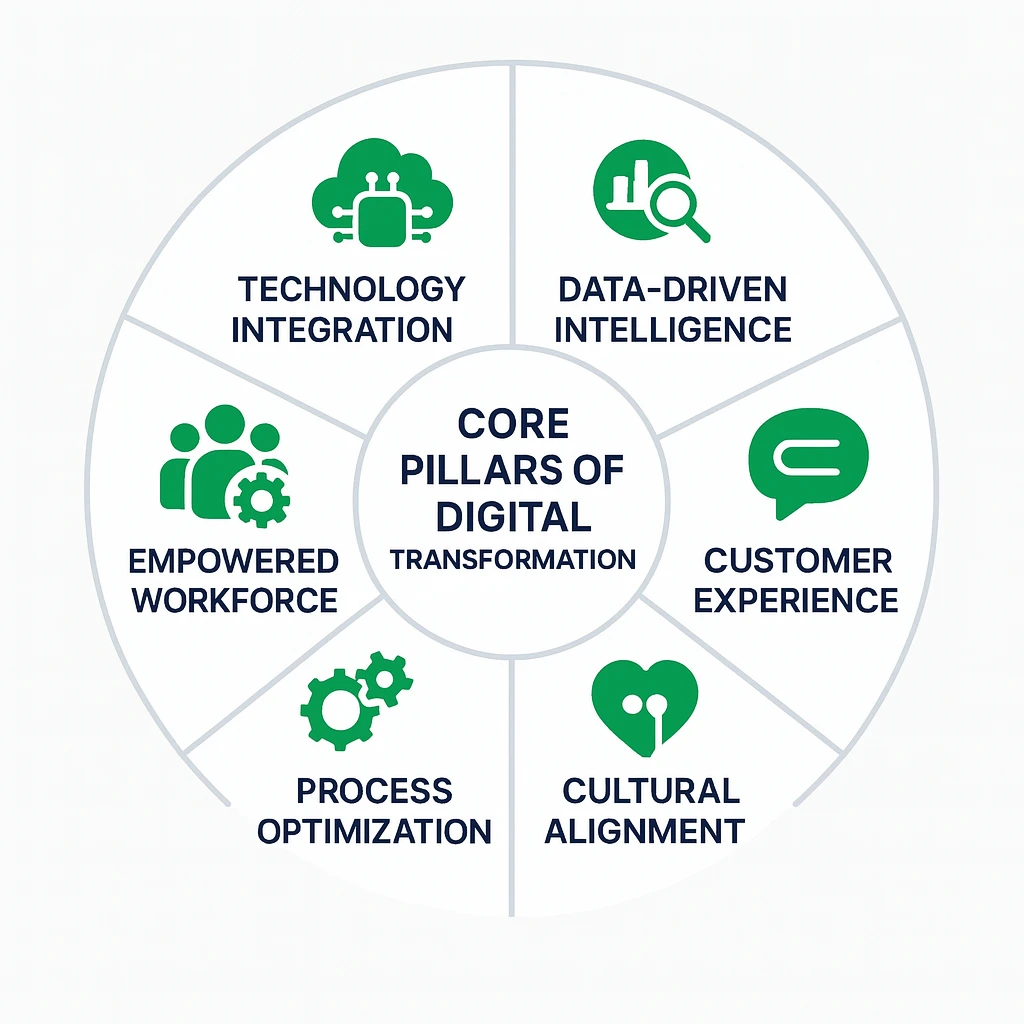
1. Technology Integration
At the heart of transformation lies scalable, flexible digital transformation technology. Cloud platforms, AI, machine learning, and automation enable faster innovation and better decision-making. These technologies are essential for modernizing infrastructure and supporting a connected business model.
2. Data-Driven Intelligence
Transformation requires more than data collection; it demands actionable insight. Organizations must build systems that enable real-time analytics, forecasting, and process automation. This is where digital transformation business process management becomes a differentiator.
3. Customer Experience
Delivering seamless, personalized interactions across channels is now a baseline expectation. From retail digital transformation to insurance, the customer journey must be optimized with intelligent automation, chatbots, and omnichannel support to enhance satisfaction and loyalty.
4. Empowered Workforce
Digital success hinges on an equipped and engaged workforce. Empowering teams with collaborative tools, self-service platforms, and on-demand learning drives both efficiency and retention. This is a critical focus in corporate digital transformation programs.
5. Process Optimization
Reengineering workflows for speed and flexibility ensures business continuity and adaptability. Companies need a clear digital transformation framework to guide the redesign of legacy systems and introduce agile operations on a large scale.
6. Cultural Alignment
Transformation is not just technical; it’s cultural. Leadership must align people, mindset, and mission to ensure adoption. This requires ongoing communication, feedback loops, and internal advocacy —hallmarks of successful digital transformation management.
What Capabilities Are Needed to Succeed in a Digital Transformation?
To execute a successful digital business transformation, organizations must cultivate core capabilities that span leadership, talent, technology, and culture:

Strategic Vision & Roadmapping
A clear digital transformation strategy, anchored in business value, ensures that investments target high-impact areas, including customer journeys, processes, or new revenue streams. This roadmap should align resources, timelines, and stakeholder accountability from day one.
Scalable Operating Model
Digital success requires a model that supports cross-functional teams, whether through digital factories, product-led squads, or enterprise-wide agile pods. This enables ongoing digital transformation management, not isolated pilots.
Distributed Technology Infrastructure
Every team needs access to the cloud, APIs, and development tools to innovate independently. A digital transformation framework facilitates this decentralization, striking a balance between governance and autonomy.
Data Accessibility & Governance
High-performing organizations build robust data architectures that empower teams to consume and act on insights, which are crucial for digital transformation and effective business process management. Data products and governance structures ensure reliability and compliance.
Change Adoption & Culture Shift
Lasting transformation hinges on adoption. For every dollar spent on technology, allocate a similar budget for change management, training, and user experience optimization. Embedding agile mindsets and iterative feedback loops enables transformation to become a sustained capability.
How to Build a Digital Transformation Roadmap
Building a structured digital transformation roadmap is crucial for aligning efforts, managing complexity, and delivering measurable outcomes. Here’s how to approach it:
1. Establish Clear Business Goals
- Define what success looks like (e.g., faster time to market, enhanced CX, cost reduction).
- Align the digital transformation strategy with overarching business priorities.
2. Evaluate Current State
- Conduct a maturity assessment of technology, processes, data, and culture.
- Identify gaps and strengths in current systems and teams.
3. Prioritize High-Impact Areas
- Focus on areas with the most significant business value, like customer experience, automation, or supply chain digital transformation.
- Use quick wins to build momentum while laying the groundwork for long-term change.
4. Segment the Roadmap into Phases
-
- Phase 1: Foundation – Upgrade infrastructure, invest in cloud, and secure platforms.
- Phase 2: Enablement – Train teams, adjust processes, and foster cross-functional collaboration.
- Phase 3: Innovation – Launch pilots, scale successful models, and adopt agile delivery.
5. Define Governance and Ownership
- Assign clear roles and responsibilities across IT, operations, and leadership.
- Integrate digital transformation management practices to ensure accountability and transparency.
6. Set Metrics and Feedback Loops
- Identify KPIs for each initiative (e.g., uptime, NPS, cycle time).
- Use iterative reviews to adjust the course and scale what works.
7. Leverage External Expertise Where Needed
- Partner with a digital transformation company or digital transformation consultancy for domain-specific support and scaling strategies.
8. Communicate the Vision and Progress
- Share milestones, wins, and insights across the organization.
- Reinforce alignment between day-to-day work and long-term transformation goals.
What are the Benefits of Digital Transformation for Businesses?
1. Enhanced Customer Experience & Loyalty
Organizations gain experience benefits by enabling customers to interact through their preferred devices, whether web, mobile, or chat. Integrations, such as AI-powered chatbots and personalized content delivery across multiple channels, enhance satisfaction and foster repeat engagement.
2. Accelerated Innovation & Agility
With a technology enterprise mindset, companies leverage hybrid cloud and custom AI to develop and deploy products faster. Agile and DevOps methodologies support continuous delivery, turning innovation into a market-driving asset.
3. Operational Efficiency Through Automation
End-to-end automation chain and process digitization streamline company processes, reducing manual work and freeing teams to focus on strategic initiatives. This increases productivity and lowers operational costs.
4. Better Workforce Engagement
Empowered teams, supported by modern tools, thrive in a culture that balances experimentation and accountability. According to Gallup, organizations with highly engaged employees consistently outperform peers in productivity, profitability, and absenteeism.
5. Resilience & Responsiveness
Digitally resilient firms can pivot quickly when market conditions shift. Whether it’s adjusting supply chains or launching new services, having an adaptable management roadmap ensures faster responses to competitive threats and evolving customer trends.
6. Stronger Cybersecurity
Emerging technologies often expose weaknesses in legacy systems. A thoughtful consulting approach to security embeds advanced protection, detects threats proactively, and safeguards data integrity across digital transformations.
7. New Revenue Streams & Business Models
Digital platforms, from e-commerce websites to mobile apps, open growth channels. AI-powered analytics help uncover cross-sell and upsell opportunities. Go-to-market strategies that include measuring service frameworks for ROI measurement further sharpen competitiveness.
8. Data-Driven Decision Making
Modern data architecture and analytics components offer real-time insights into customer behavior, operations, and market trends. This allows businesses to make faster decisions that align with both tactical and strategic goals.
Industry-Specific Applications of Digital Transformation
Across various industries, including banking, healthcare, manufacturing, retail, and energy, businesses are redefining their operations, enhancing customer experiences, and unlocking new value through digital transformation.
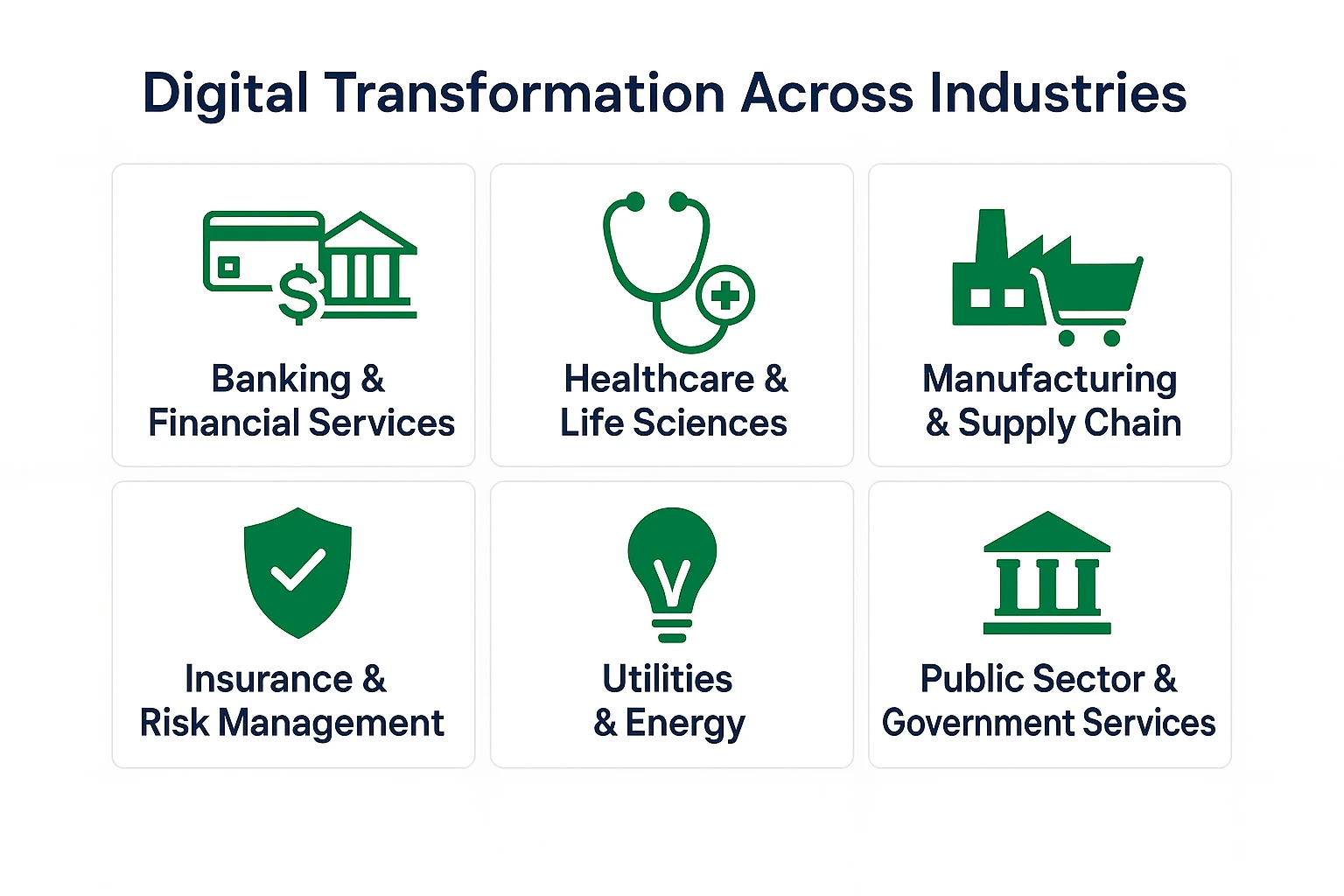
Banking & Financial Services
- Automation of fraud detection and digital payments increases speed and security.
- Intelligent data flows enable the development of personalized financial products and facilitate real-time risk analysis and management.
Healthcare & Life Sciences
- Telemedicine and connected devices empower remote diagnosis and continuous patient care.
- Analytics-driven systems improve treatment plans and optimize hospital operation
Manufacturing & Supply Chain
- IoT-connected machinery, smart logistics, and predictive maintenance reduce downtime and increase output.
- The digitalization of procurement and inventory systems accelerates sourcing and enhances traceability.
Retail & E-commerce
- Omnichannel platforms, AI-driven recommendations, and mobile purchasing cater to modern consumer demands.
- Integration of backend systems ensures seamless order fulfillment and enhances the overall customer experience.
Insurance & Risk Management
- Claims automation and chatbots provide fast, consistent service.
- Data-enabled modeling enhances underwriting, fraud detection, and personalized offerings.
Utilities & Energy (Oil & Gas)
- Smart grid systems optimize resource distribution and energy usage.
- Remote monitoring and operational automation improve safety and reduce costs in field operations.
Public Sector & Government Services
- Digital portals enhance citizen engagement and streamline procurement processes.
- Utility digitization supports better resource management and service delivery.
HR & Organizational Platforms
- Remote-first workplaces utilize self-service apps, digital onboarding, and collaboration tools.
- Workforce analytics help improve employee satisfaction and performance.
Digital Transformation Challenges – Address Common Obstacles and How to Overcome Them
Despite its promise, digital transformation is a complex journey that strategic, technical, and cultural barriers can derail. Below are some of the most common challenges, along with practical insights on how to overcome them effectively.
1. Strategic Ambiguity
One of the biggest pitfalls is launching digital initiatives without a clear management roadmap. Without alignment between leadership and operational teams, transformation becomes tactical rather than strategic.
Solution: A strong business lead must champion the initiative, supported by measurable milestones and cross-functional collaboration.
2. Legacy Systems and Technical Debt
Outdated IT infrastructure can cripple even the most innovative plans. These systems lack the flexibility needed for scaling custom AI, automation, or real-time analytics.
Solution: Replacing or modernizing these components through scalable digital transformation solutions enables a more agile, cloud-based technology enterprise model.
3. Talent and Skill Gaps
Transformation demands a new level of expertise across engineering, data science, and experience design. Companies often lack the internal resources or new talent to deploy or maintain new systems.
Solution: A hybrid consulting approach, blending internal capability with external specialists, which can accelerate adoption and reduce risk.
4. Cultural Resistance to Change
Digital success isn’t just a technicality; it’s a culture. Employees resist change when it disrupts routines or threatens roles.
Solution: Embedding agile practices, celebrating quick wins, and offering ongoing training fosters buy-in.
5. Data Silos and Poor Integration
Data remains trapped in departmental silos, making real-time insight or AI automation nearly impossible. This integration is a key component of modern transformation.
Solution: Unifying data through a centralized architecture improves visibility and enhances decision-making throughout the company’s processes.
6. Insecure or Reactive Cybersecurity
Security concerns often delay transformation, especially in B2B digital transformation or industrial projects where compliance is critical.
Solution: Embedding cybersecurity from the start and adopting proactive monitoring ensures resilience while reducing exposure to threats.
What are the Key Digital Transformation Trends in 2025
Digital transformation in 2025 is evolving rapidly, shaped by user behavior, intelligent systems, and ecosystem-wide collaboration. Businesses that recognize and adopt these emerging success trends are well-positioned to drive market-leading innovation and achieve long-term growth.
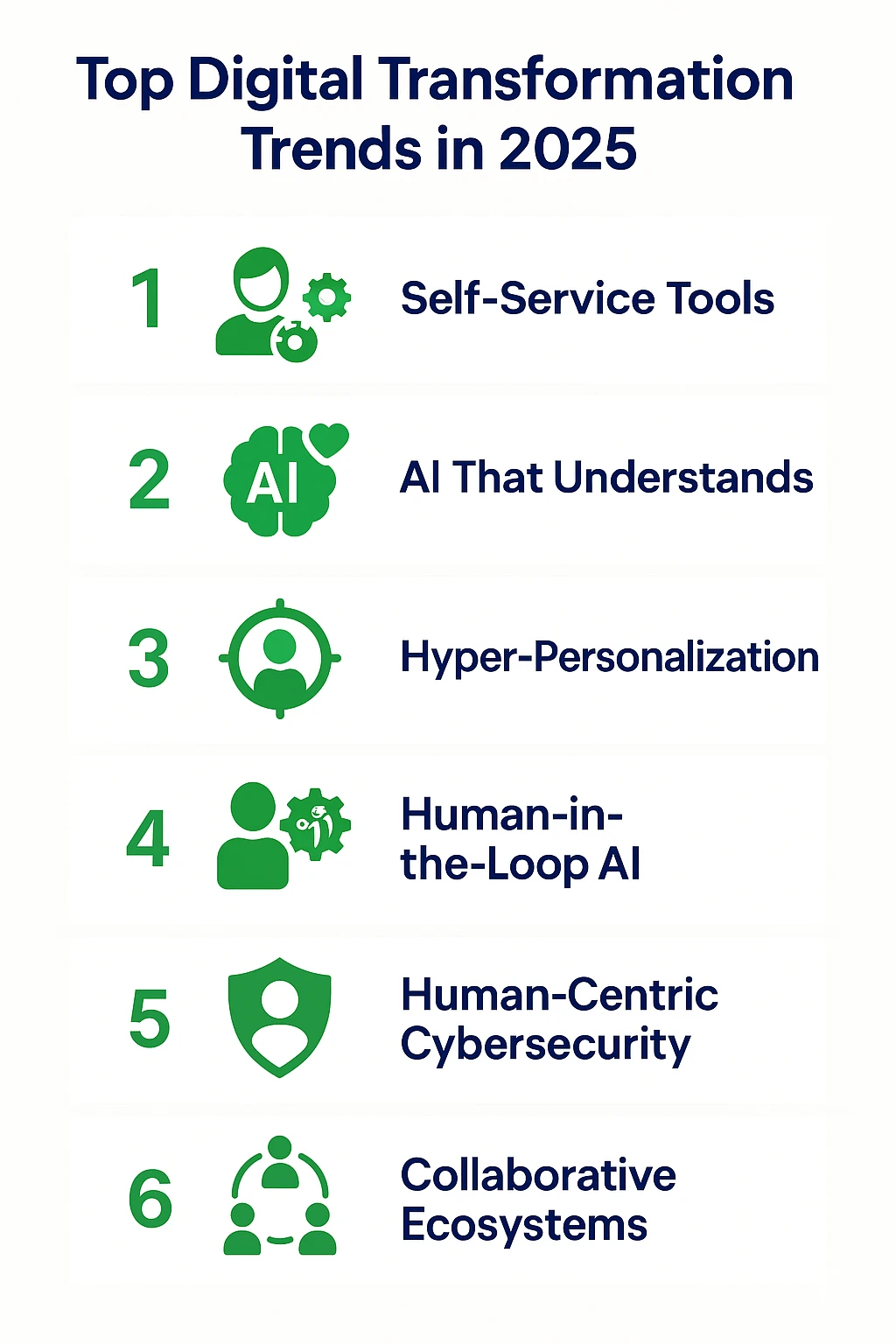
1. Self-Service Tools Reshape Company Processes
The rise of self-service business intelligence, forecasting, and automation tools empowers employees at every level to innovate. By democratizing access to data and eliminating traditional bottlenecks, organizations can accelerate decision-making and enhance agility across their company processes. This trend aligns transformation with the needs of a modern workforce that is intuitive, responsive, and user-driven.
2. AI That Understands, Not Just Automates
Organizations are shifting from simply adopting AI to focusing on how it serves real human needs. The priority is understanding what customers want and using custom AI to create seamless, frictionless experiences. This mindset transforms AI from a tactical tool to a strategic differentiator within the automation chain.
3. Hyper-Personalization Through Intelligent Data
Fueled by real-time analytics and machine learning, hyper-personalization is redefining customer engagement. From e-commerce to finance, businesses are tailoring content, recommendations, and services based on individual behavior. These components not only enhance loyalty but also boost ROI and experience benefits.
4. Human-in-the-Loop AI for Scalable Trust
Despite advances in AI, human oversight remains vital. The human-in-the-loop model enables organizations to manage risks such as bias or hallucination while refining algorithmic performance. This strategy strikes a balance between innovation and safety, supporting long-term strategies in regulated sectors such as finance and healthcare.
5. Human-Centric Cybersecurity
Modern cybersecurity strategies prioritize user behavior and adhere to zero-trust principles. AI-driven threat detection now adapts in real-time without hampering productivity. Embedding these frameworks protects critical data while supporting seamless and secure user experiences, an essential component in any technology enterprise.
6. Collaborative Ecosystems
Forward-thinking organizations are building collaborative platforms where partners, teams, and customers co-create value. These ecosystems foster innovation and inclusion, especially in industrial projects and complex supply chains. This consulting approach encourages shared goals and scalable transformation.
Premier NX: Supporting Your Digital Transformation Journey
Digital transformation today is about more than technology; it’s about making meaningful improvements to how businesses operate, serve customers, and adapt to change. Premier NX provides structured, practical services that enable organizations to transition to more efficient, data-driven, and resilient operations.
Cloud Migration & Management
Premier seamlessly modernizes your infrastructure with secure transitions to platforms like Amazon Connect, Zoom, and Genesys. We reduce downtime and optimize performance for scalable, cloud-native environments.
AI Integration & Automation
We integrate AI and RPA to automate manual processes, boost productivity, and enhance decision-making. Our solutions align with your goals to deliver tangible efficiency gains.
Data Management & Insights
From ETL pipelines to advanced analytics, Premier transforms data into strategic assets. Gain clarity, accuracy, and speed in every decision you make.
Security & Compliance
Premier protects your digital ecosystem with proactive security assessments, compliance monitoring, and infrastructure hardening designed for today’s evolving threat landscape.
DevOps & App Development
We accelerate innovation with agile DevOps workflows and scalable custom applications. We help you deliver faster, safer, and more tailored digital products.
Technical Support & Managed Services
Premier NX keeps your systems running smoothly with 24/7 support and managed services. We handle IT complexity so your team can focus on core growth activities.
Ready to Redefine Your Customer Experience?
Digital transformation isn’t just a future goal—it’s a present necessity. Whether you’re modernizing your infrastructure, integrating AI, or optimizing workflows, Premier NX offers the strategy, technology expertise, and execution needed to make it happen.
Let’s build your digital future together.
Connect with our experts to explore tailored solutions that drive measurable outcomes, reduce complexity, and position your organization for long-term growth.